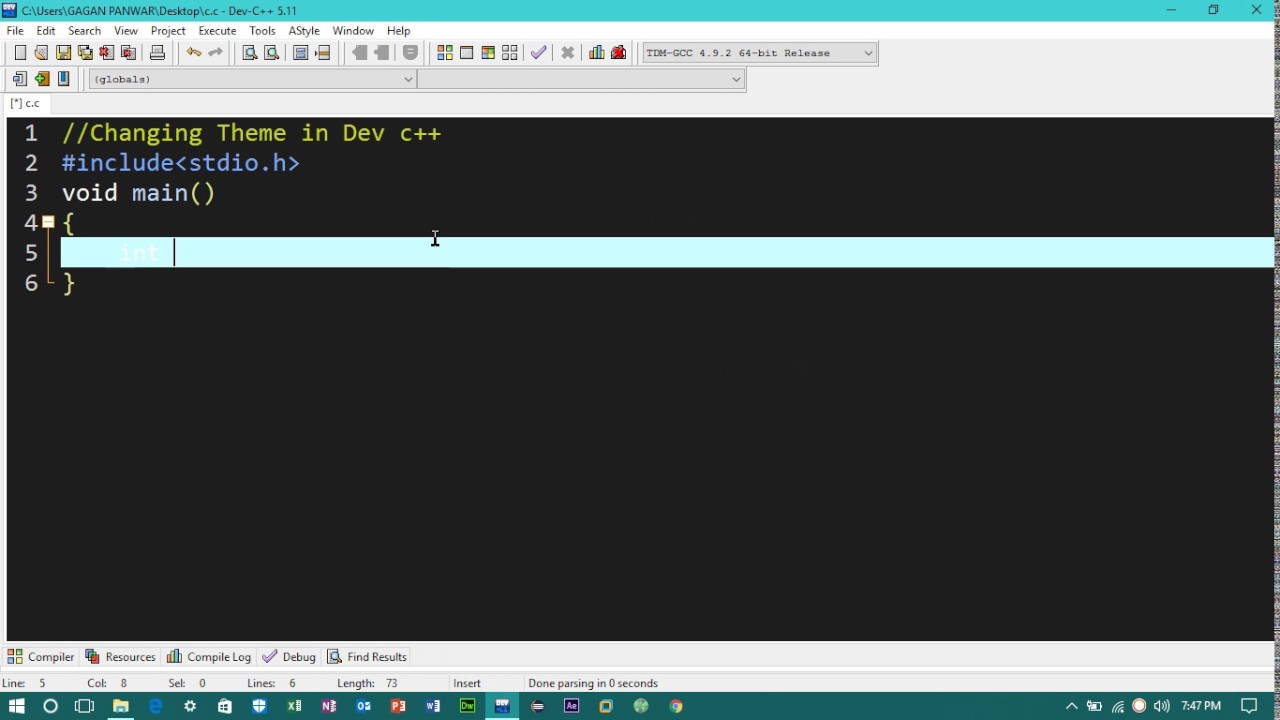
What Is The Oblivion Theme Dev C++
The Elder Scrolls IV: Oblivion is an open-world action role-playing video game developed by Bethesda Game Studios and published by Bethesda Softworks and the Take-Two Interactive division 2K Games. It is the fourth installment in The Elder Scrolls action fantasy series, following The Elder Scrolls III: Morrowind and preceding The Elder Scrolls V: Skyrim. Jul 03, 2018 change theme of Dev c. World's Most Famous Hacker Kevin Mitnick & KnowBe4's Stu Sjouwerman Opening Keynote - Duration: 36:30. Cyber Investing Summit Recommended for you. OnlineGDB is online IDE with C compiler. Quick and easy way to compiler c program online. It supports g compiler for c. Switch to Code::Blocks. The underlying compiler is the same (gcc with MinGW), and the IDE is vastly superior in my opinion. Also, Dev-C is no longer under development and Code::Blocks is being actively worked on. Is aesthetics important? The answer is subjective.
Nov 29, 2016 Delphi is the ultimate IDE for creating cross-platform, natively compiled apps. Are you ready to design the best UIs of your life? Our award winning VCL framework for Windows and FireMonkey (FMX) visual framework for cross-platform UIs provide you with the foundation for intuitive, beautiful.
| Developer(s) | The Code::Blocks team |
|---|---|
| Initial release | 2005; 15 years ago |
| Stable release | 20.03 / March 29, 2020; 20 days ago |
| Repository | |
| Written in | C++ (wxWidgets) |
| Operating system | Cross-platform |
| Type | IDE |
| License | GNU GPLv3[1] |
| Website | codeblocks.org |
| Usage | |
Code::Blocks is a free, open-sourcecross-platformIDE that supports multiple compilers including GCC, Clang and Visual C++. It is developed in C++ using wxWidgets as the GUI toolkit. Using a plugin architecture, its capabilities and features are defined by the provided plugins.Currently, Code::Blocks is oriented towards C, C++, and Fortran. It has a custom build system and optional Make support.
Code::Blocks is being developed for Windows and Linux (the latest macOS version is 13.12 released on 2013/12/26) and has been ported to FreeBSD[2], OpenBSD[3] and Solaris.[4]
History[edit]
After releasing two release candidate versions, 1.0rc1 on July 25, 2005 and 1.0rc2 on October 25, 2005, instead of making a final release, the project developers started adding many new features, with the final release being repeatedly postponed. Instead, there were nightly builds of the latest SVN version made available on a daily basis.[citation needed]
The first stable release was on February 28, 2008, with the version number changed to 8.02. The versioning scheme was changed to that of Ubuntu, with the major and minor number representing the year and month of the release. Version 20.03 is the latest stable release; however for the most up-to-date version the user can download the relatively stable nightly build or download the source code from SVN.
Jennic Limited distributes a version of Code::Blocks customized to work with its microcontrollers.[5]
Features[edit]
Compilers[edit]
Code::Blocks supports multiple compilers, including GCC, MinGW, Digital Mars, Microsoft Visual C++, Borland C++, LLVM Clang, Watcom, LCC and the Intel C++ compiler. Although the IDE was designed for the C++ language, there is some support for other languages, including Fortran and D. A plug-in system is included to support other programming languages.
Code editor[edit]
The IDE features syntax highlighting and code folding (through its Scintilla editor component), C++ code completion, class browser, a hex editor and many other utilities. Opened files are organized into tabs. The code editor supports font and font size selection and personalized syntax highlighting colours.
Debugger[edit]

The Code::Blocks debugger has full breakpoint support. It also allows the user to debug their program by having access to the local function symbol and argument display, user-defined watches, call stack, disassembly, custom memory dump, thread switching, CPU registers and GNU Debugger Interface. Sausage fattener vst mac download.
GUI designer[edit]
As of version 13.12 Code::Blocks comes with a GUI designer called wxSmith. It is a derivative port of wxWidgets version 2.9.4.[6] To make a complete wxWidgets application, the appropriate wxWidgets SDK must be installed.
Oblivion Theme Music
User migration[edit]
Some of Code::Blocks features are targeted at users migrating from other IDE's - these include Dev-C++, Microsoft Visual C++ project import (MSVC 7 & 10), and Dev-C++ Devpak support.
Project files and build system[edit]
Code::Blocks uses a custom build system, which stores its information in XML-based project files. It can optionally use external makefiles, which simplifies interfacing with projects using the GNU or qmake build systems.
What Is The Oblivion Theme Dev C Full
See also[edit]
References[edit]
- ^'License'. Retrieved 2014-07-21.
- ^Code::Blocks in FreeBSD's ports collection
- ^Code::Blocks in OpenBSD's ports collection
- ^Directions to install Code::Blocks from source on Solaris
- ^JN-UG-3028 Code::Blocks IDE User Guide
- ^CodeBlocks 13.12 Changelog
External links[edit]
What Is The Oblivion Theme Dev C 2017
| Wikimedia Commons has media related to Code::Blocks. |
- Official website
Oblivion Theme Song